
Have you ever set a health goal such as “lose 10 pounds”, “run a faster mile”, “exercise more”, only to watch your motivation fade after a few weeks? For many people, the cycle of starting strong and then drifting off course feels all too familiar. Discipline is rarely the problem; most goals are missing a deeper foundation.
We also tend to pick that goal before looking at the whole picture. We choose the area that already bothers us, usually weight or fitness, and leave the rest unexamined. Six months later the goal has stalled, and the reason sits somewhere else entirely: five hours of sleep a night, a job that takes every evening, or nobody at home eating the same dinner. A wellness wheel puts all eight areas of your health on one page, so you can score each one and find the low areas you have not been counting.
What Is a Wellness Wheel?
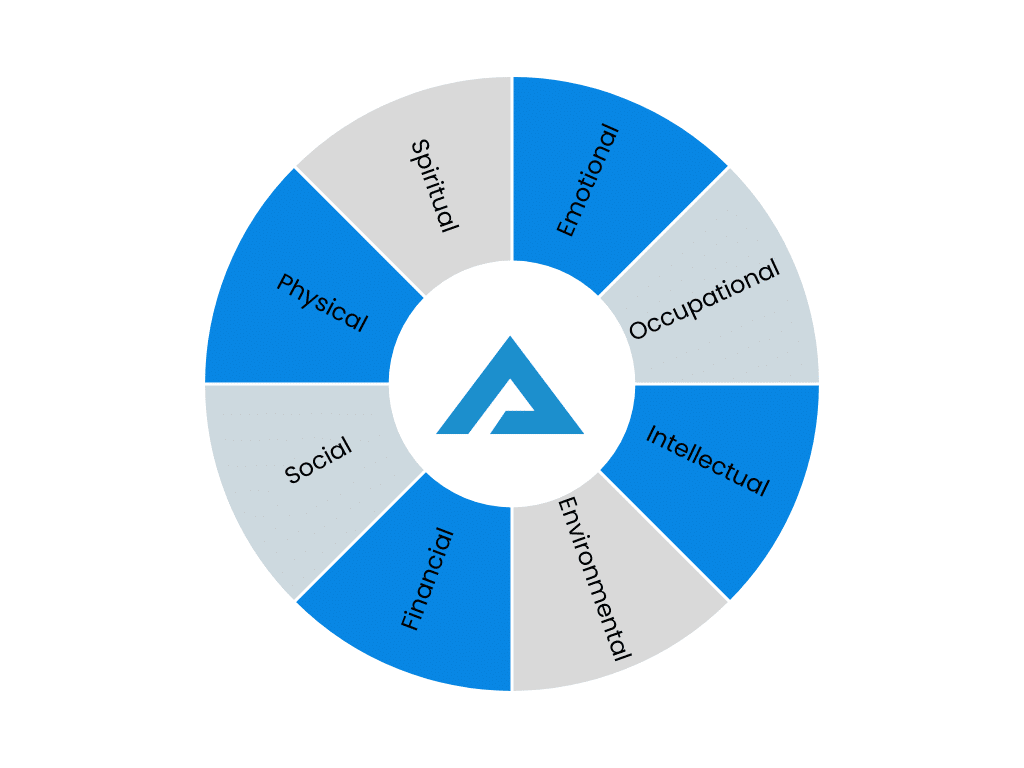
A wellness wheel is a circle split into eight sections, one for each dimension of wellness. You rate your satisfaction with each section from 0 to 10, and the shape that comes out shows you where your life is full and where it is thin. University of New Hampshire Extension describes the wheel as a visual representation of a person’s own perception of their overall wellness, used to help identify core health values and goals.
Two things are worth saying before you fill one in. The wheel records how you feel about each area on the day you score it, so the same person can draw two different wheels a month apart and be right both times. And it measures nothing clinically. Two people with identical bloodwork can produce very different wheels, because the wheel is asking about satisfaction rather than about test results.
A wellness wheel is a reflection exercise, not a diagnosis. If a low score reflects something you are worried about medically, that belongs in a conversation with your physician rather than on a wheel.
The 8 Dimensions of Wellness
The eight dimensions below are the ones used across university and public health wellness programs, including the model published by UC Davis Student Health and Counseling Services. They are the eight sections in our own wheel above, reading clockwise from the top.
Emotional
How aware you are of what you feel, and how you respond to the ordinary friction of a day.
Occupational
Whether your work gives you enough satisfaction and meaning that it does not drain the other seven areas.
Intellectual
Learning, reading, and creative work that keeps your mind engaged outside of your job.
Environmental
The spaces you spend your hours in, at home, at work, and outdoors, and whether they let you rest or keep you on edge.
Financial
Managing what you earn and what you spend without steady worry about the next bill.
Social
Relationships close enough that you would call one of those people at ten at night and not feel bad about it.
Physical
Sleep, movement, food, and medical care, and whether your body can do what your day asks of it.
Spiritual
A sense of meaning, and a set of values you make real decisions by.
Our Health Coaches work hands-on in three of these eight: physical, emotional, and social. The other five come up in coaching conversations often, because they set the conditions the first three have to survive inside. A member scoring a 3 on occupational wellness while working sixty-hour weeks does not need a harder training plan. That member needs a plan built for sixty-hour weeks, which is a different conversation. If you are weighing what a coach does that a trainer does not, we wrote about the difference between a health coach and a personal trainer separately.
Some of these sections have their own article on this site. For the physical section, our exercise physiologists have written on why muscular power is essential for fitness and function and on how to start eating healthy without picking a diet. For the social and emotional sections, the piece on staying healthy while caring for children and parents at the same time covers the case we see most often: people carrying children and aging parents at the same time.
Wellness Wheel Assessment: Rate All 8 Areas
Score each of the eight areas from 0 to 10 based on how satisfied you are with it right now, not on how satisfied you think you ought to be. The wheel fills in as you move each slider. Nothing is recorded and nothing is sent anywhere, so you can be blunt with yourself. Once all eight are set, you will get your average, your two lowest areas, and a suggestion for where to start.
Your Wellness Wheel
Eight sliders, about two minutes. Nothing you enter is recorded or sent anywhere.
Wheel of Life vs. Wellness Wheel
If the exercise above looked familiar, you have probably seen a wheel of life. The two are the same exercise wearing different section labels. The wheel of life came first: Positive Psychology traces it to Paul J. Meyer in the 1960s, and it spread through life coaching with sections such as career and work, money and finances, fun and recreation, partner and love, and personal growth.
The wellness wheel keeps the health labels and uses the eight dimensions listed above. Both versions ask the same question in the same way, and both work. We use the eight wellness dimensions for one reason: they map onto things a health coach and an exercise physiologist can act on with you in the next ninety days. “Fun and recreation” is a fair thing to score. It is harder to build a plan around than sleep, movement, and who you eat dinner with.
Reading the Shape You Drew
The number that comes back is less useful than the shape. Three shapes turn up again and again in the wheels our coaches see, and each one points somewhere different.
Three shapes, three starting points
Select a shape to see what it usually means and where to begin.
This is the most common wheel our coaches see, and it is the easiest one to act on. A single low section tends to explain more of a stalled goal than the seven healthy ones explain progress. Start with the lowest one, and resist the pull to start with the section you enjoy working on. Someone who scores an 8 on physical and a 3 on social does not need another training block. That person needs one standing commitment with other people in it, which is also why our members train in small groups rather than alone.
An even, small wheel usually means capacity, not any single failing area. Something outside these eight sections is taking most of your week, and each section is getting a thin slice of what is left. Adding a new health goal on top of this shape tends to fail within a month. Pick one section, get it to a 7, and re-score the wheel in ninety days. In our experience the other sections move up on their own more often than people expect, because more sleep and more energy show up in almost every other section.
A nearly full wheel means the exercise has done its job and you do not need to change course. Two things are still worth doing. Write the date on it, because a full wheel is a snapshot of a good stretch and not a permanent state. And re-score it in ninety days, particularly after any change in job, household, or health, since those are the events that pull one section down fast while the others stay put.
Whichever shape you drew, the next step is the same, and it is the part Chris talks about with every member he works with.
Our longest-serving Health Coach, Chris, recently shared how this next concept can change the way you approach your health. He explained how creating a wellness vision gives you something stronger than willpower, it gives you a north star that keeps you moving forward, even in the weeks when everything else slips.
What Is a Wellness Vision?
A wellness vision is more than a goal, it’s a guiding picture of your best, healthiest self. Instead of focusing only on numbers (“I want to lose weight” or “I’ll work out three times a week”), a wellness vision asks deeper questions:
- Who do you want to be?
- How do you want to feel every day?
- What do you want your health to help you do with the people who matter most?
One rule matters more than the wording: write it in the present tense, as something already true, rather than as something you want. So instead of “I want to lose 20 pounds,” your wellness vision sounds like this:
“I am strong, energetic, and vibrant. I am hiking with my kids and am able to enjoy life and what my body is capable of.”
This kind of vision taps into your values and identity, not just your to-do list. And that’s exactly what a Health Coach is trained to help you uncover.
Why a Wellness Vision Matters
Most traditional health goals fail not because they’re unrealistic, but because they don’t have staying power. A number on the scale might motivate you for a while, but when stress or setbacks appear, it’s easy to lose focus.
A wellness vision shifts that. It becomes your internal compass, a bigger “why” that anchors your decisions and habits. Instead of seeing challenges as failures, you start to see them as learning opportunities. That perspective creates resilience and sustainability.
As Chris put it: a wellness vision gives you a reason to keep going, even when motivation fades. And when you’re supported by a Health Coach who keeps that vision front and center, change becomes far more likely to stick. Keeping it front and center is most of the job, and our post on the five ways health coaches keep you on track goes through how that works week to week.
How to Begin Crafting Your Wellness Vision
Building a wellness vision doesn’t have to be complicated. Here’s where to start, and your wheel from earlier gives you a head start on step one.
- Reflect on your values. What matters most to you: family, freedom, confidence, energy? Your vision should align with these. Your two lowest wheel sections are often where a value you hold is going unmet.
- Picture your best self. Imagine yourself a year from now, living with the health and vitality you want. What does a normal Tuesday look like? How does your body feel? Who is there with you?
- Put it into words (or images). Write a short statement, create a journal entry, or even build a vision board that captures your healthiest life. Write it in the present tense, as though you are already living it. “I am” and “I am doing,” not “I want” or “I will.”
- Revisit it daily. Place your vision where you’ll see it, on your mirror, your phone background, or your fridge. Let it remind you of the person you’re becoming.
A Health Coach can guide you through each of these steps, helping you clarify your vision and connect it to realistic, actionable goals.
From Vision to Action
A wellness vision isn’t about perfection, but more about direction. Once you have yours, the next step is setting smaller goals that align with it. That’s where a Health Coach does the most work: turning your vision into milestones you can hit this month, while keeping the year in view.
Health Coaches build that plan with you. It gets sized to the schedule you have, the strengths you already bring, and the goals you named yourself. When you stop chasing quick fixes and start building a future you want, health becomes less of a chore and more of who you are.
A practical way to start: score your wheel today, write the date on it, pick the lowest section, and re-score in ninety days. That is one number to beat, on a date you have already set.
Need more support?
MY180 pairs you with a Health Coach for weekly check-ins, a Registered Dietitian, and an Exercise Physiologist, working from one plan across 180 days. If more than one of your sections came back at 4 or below, MY180 is built for that situation.
Talk With a Health Coach
References
- University of New Hampshire Extension. Wellness Wheel Assessment.
- UC Davis Student Health and Counseling Services. Eight Dimensions of Wellness.
- Positive Psychology. The Wheel of Life: How to Apply It in Coaching.