
Your training follows four deliberate phases over 24 weeks, and each one builds on the last. Here is the whole plan in one place, plus a quick quiz to check how well you know your own program.
Start here
Periodization is the practice of organizing your training into distinct phases, each with a specific goal, so that physical adaptations build on one another over time. Your Exercise Physiologist uses a linear periodization training program that runs 24 weeks across four phases. Each phase prepares your body for the demands of the next.
Builds the foundation: work capacity, movement quality, and resilient tissue.
Builds the muscle. More load, fewer reps, more total sets.
Teaches your body to use that muscle. Heavier loads, fewer reps, the nervous system leads.
The ceiling. Peak loads, low reps, everything before it converges.
Every month, your EP checks in, reviews your history, and moves you to the next phase through the ExRx process.
The idea comes from early 20th-century Russian training theory, where coaches found that athletes who trained in organized, phase-based blocks improved more consistently than those who simply trained hard without a plan. That core idea still holds, and it is no longer reserved for athletes.
Research now supports periodization for general fitness populations, including older adults, where organized, progressive training improves strength, physical function, and tolerance for harder work later on. The thread running through every effective program is that the training is progressive and well organized, so each block of work sets up the one after it. Your body responds to work that builds on itself.
This is why your plan starts lighter than you might expect. The early weeks do real work: they build the base that decides how much you get from every phase that follows. When a phase feels manageable, that is the plan doing its job. For the full picture, each phase below opens a deeper dive and links out to the complete article. Start with Phase 1 →
The four phases
The movement patterns stay the same throughout: squat, hinge, push, pull, and rotate. What changes each phase is the load, the reps, the tempo, and the goal. Open any card for a deeper dive, then read the full article.
 1 Strength Endurance · Wk 1–6
The foundation. Moderate load, higher reps, and a controlled tempo build work capacity, movement quality, and resilient tendons for everything that comes next.
Phase 1 runs the foundational movement patterns at a moderate load and a controlled 3/2/1 tempo, which means three seconds lowering, a two second hold, then one second lifting. You stop each set with one to three reps still in you, so you get a strong training effect without the fatigue that stalls early progress.
Those six weeks drive four adaptations: work capacity so your muscles can handle later volume, better energy production inside the muscle cell, movement quality from hundreds of clean reps, and tougher tendons and connective tissue that lower injury risk as loads climb.
It splits in half. Weeks 1 to 3 sit at the higher end of the rep range to build familiarity and volume. Weeks 4 to 6 move to slightly heavier loads and fewer reps. By the end you carry more capacity into the hypertrophy phase.
 2 Hypertrophy · Wk 7–12
This is where you build muscle. The reps drop, the load goes up, and total sets increase. More muscle tissue is the raw material that makes the later strength phases productive.
Phase 2 keeps the same movement patterns but raises the load. Reps drop to 8–12, sets rise to three or four, intensity climbs to 65–80% of your max, and the tempo moves to 3/1/1. You stop each set with one to two reps left.
The goal is muscle. Hypertrophy is the process where muscle fibers grow in cross-sectional area, and more muscle tissue is the raw material that later strength work turns into force.
Expect a little more soreness in the first two weeks. That reflects the repair cycle that builds muscle. Sleep, enough protein, and 48 to 72 hours between sessions for the same muscle groups keep it in check.
 3 Strength · Wk 13–18
Now you put that muscle to work. Heavier loads, fewer reps, and a focus on the big compound lifts bring the nervous system to center stage.
Phase 3 turns muscle into strength. Reps drop to 6–8, intensity rises to 75–85% of your max, sets move to four or five on the main lifts, and rest sits at one to two minutes.
The nervous system leads here. Heavier loads teach your body to recruit more muscle fibers and fire them in better coordination, so the muscle you built in Phase 2 starts to show its full strength.
Training centers on the big compound lifts like squats, presses, rows, and hinges, where that force carries over most to daily life.
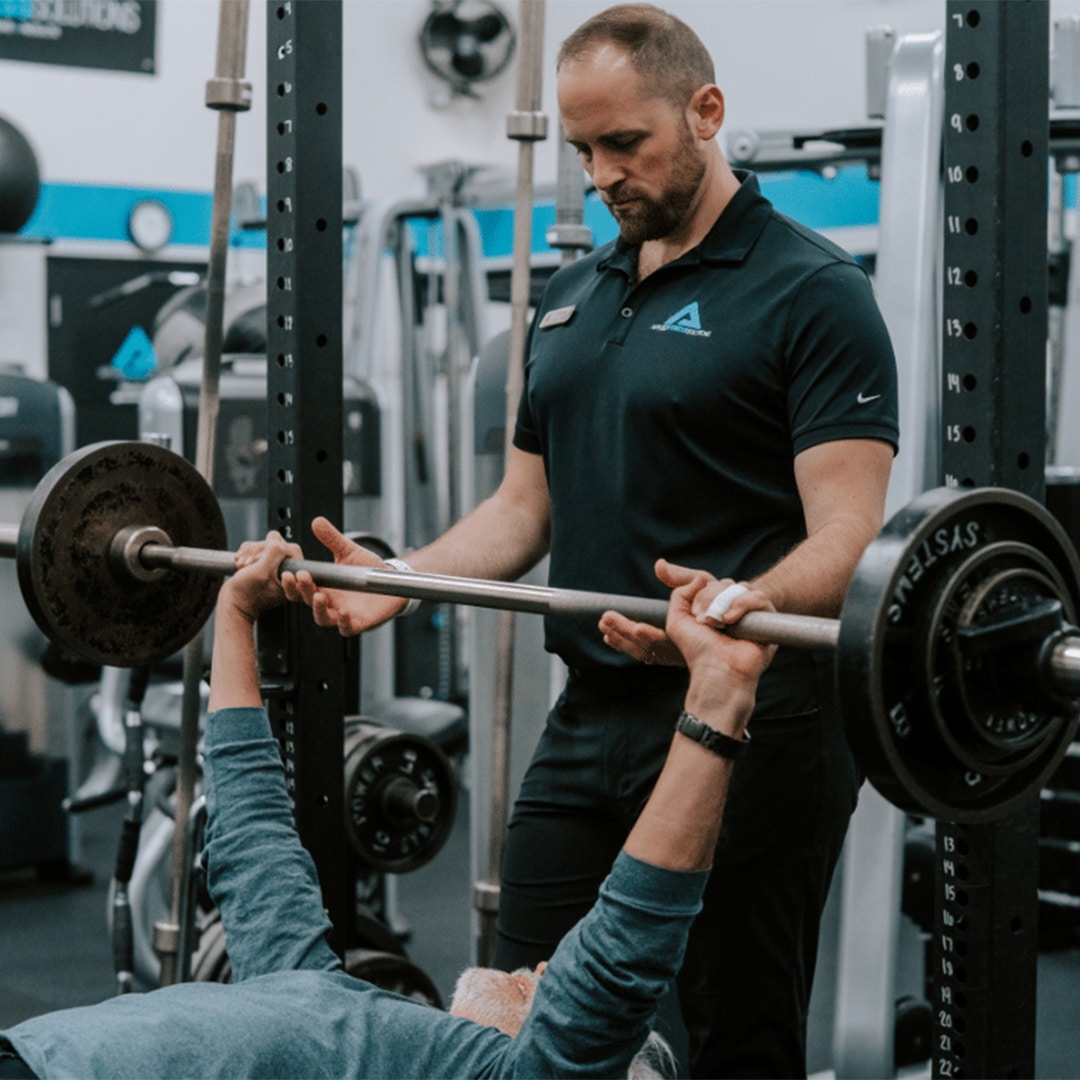 4 Absolute Strength · Wk 19–24
The ceiling. Low reps at peak load, short focused rest, and full precision on every rep. Every adaptation from the first three phases comes together here.
Phase 4 is the ceiling. Reps sit at four to six, intensity climbs to 80–90% of your max, sets run three to five, and rest holds at one to two minutes so every set delivers quality effort.
Every rep is about quality and peak neural drive. This is where the work capacity, muscle, and coordination from the first three phases all come together into your highest strength.
It only delivers because of what came before it. Skip the earlier phases and this one carries more risk and returns less.
Test yourself
Eight quick questions on what each phase means for your workouts. Get one wrong and we will point you straight to the article that clears it up.
Members & non-members
Have a question about the process, or want to see where you fit? Reach out and we’ll answer anything. A readiness screening is always free.